Prince–Kimura coercive relationship
Bullet TrainThe Prince–Kimura coercive relationship turns a father’s concern for his son into an instrument of control. The Prince does not rely on physical force alone: he threatens Wataru, manipulates what Kimura is allowed to say, and uses pain to enforce obedience. Kimura’s responses move between caution, restraint, and resistance. Their encounters expose the Prince’s effort to make compliance feel inevitable, while showing that even his carefully maintained advantage can provoke a counterattack.
A threat directed through Wataru
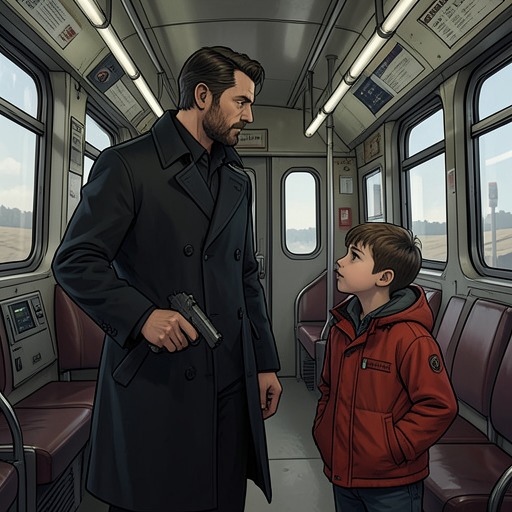
The relationship takes shape around Wataru’s vulnerability. The Prince tells Kimura that a friend is waiting near the hospital where Wataru is being cared for. That friend has already called to ask when he can act, and the Prince says he has told him to wait. The arrangement makes Wataru’s safety appear dependent on the Prince’s decisions: the Prince can give the signal, or his failure to answer can itself be taken as permission. Kimura understands the consequence without needing it spelled out. When the Prince describes Wataru’s death as something he could present as environmentally beneficial, Kimura recognizes the provocation and tries to contain his anger rather than give the Prince the reaction he is seeking.
This threat makes the coercion unusually intimate. The Prince is not merely using Kimura’s own safety to secure submission; he places Kimura’s fear for his son at the center of the exchange. He varies how he refers to Wataru, sometimes emphasizing that he is Kimura’s son and sometimes reducing him to a diminutive, and Kimura notices that the choice is deliberate. The shifts in wording are part of the pressure: the Prince controls not only the threatened outcome but also the terms in which Kimura is forced to imagine it.
The danger is set within a larger chain of delegated violence. Minegishi had commissioned Tangerine and Lemon to rescue his son, recover the ransom money, and kill those involved in the kidnapping, in that order of priority. Nanao’s work is itself described as subcontracted through another client. Later, Minegishi says that people will check on the situation at Sendai Station. These arrangements establish a world in which orders pass through intermediaries and the consequences of a mistake may arrive from an unseen employer. Against that background, the Prince’s claimed access to a waiting accomplice gives his threat a practical frame, even as the evidence of the relationship focuses on the leverage he exercises over Kimura.
Instructions, restraint, and punishment
The Prince also attempts to direct Kimura’s conduct through deception. He tells Kimura to take a call from his father and ask for help, but instructs him not to mention Wataru. The omission is central: the Prince wants Kimura to seek assistance while concealing the fact most likely to change how his father responds. The request turns a family conversation into another test controlled by the Prince, who determines both what Kimura should do and what information he must withhold.
When Kimura does not remain within the Prince’s rules, the Prince imposes a painful penalty. He presents punishment as the consequence of losing a game, although Kimura points out that the contest was unfair. The Prince uses a concealed needle and threatens to continue if Kimura makes noise. He then connects Kimura’s silence directly to Wataru’s safety, warning that another outcry will trigger a call against the boy. The threat converts endurance into compliance: Kimura must manage his immediate pain while also calculating what any act of resistance might cost his son.
The Prince’s own reasoning makes clear that he regards obedience as a system for lowering another person’s status. He believes that once someone follows a command, further commands become easier, and that reversing this downward movement is difficult. His control therefore depends on repeated acts of submission, not simply on possessing a weapon or an accomplice. The punishment is meant to teach Kimura that the Prince sets the rules and that even Kimura’s reactions can be made to serve those rules.
Kimura’s resistance and the Prince’s satisfaction
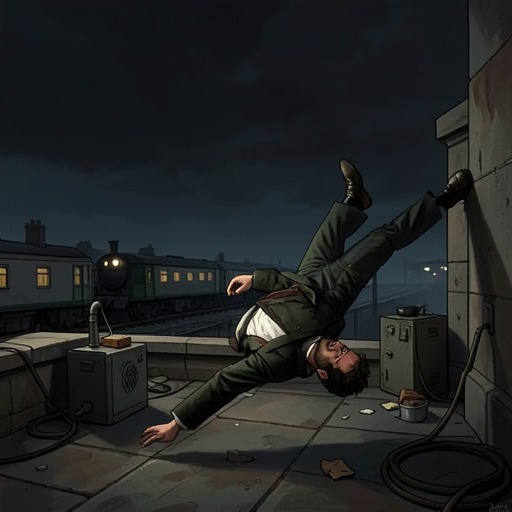
Kimura tries to keep his anger from becoming an opening the Prince can exploit. During the threat against Wataru, he identifies the Prince’s words as calculated provocation and warns himself not to be drawn in. Under punishment, however, the strain reaches a limit: Kimura strikes the Prince with his knee and elbow. His response is not a clean escape from the coercive situation. It is accompanied by both triumph and horror at what he has done, while the Prince quickly resumes taunting him and invokes his own reputation for patience. The sudden reversal interrupts the Prince’s control, but does not remove the threat against Wataru that has made Kimura cautious.
The Prince interprets Kimura’s fear in a radically different way. Looking back on the exchange, he dwells on Kimura’s inability to speak and on the desperation that followed the threat to Wataru. He takes satisfaction in making a man who was already near death feel more hopeless, and regards Kimura’s struggle to beg for his son as amusing. The contrast clarifies the imbalance between them: Kimura’s silence is bound to a real fear for Wataru, while the Prince treats that fear as a spectacle and as evidence of his own power.
Limits and significance of the relationship
The Prince’s control is powerful because it joins several pressures together: a credible threat to Wataru, instructions that restrict Kimura’s communication, and punishment intended to make disobedience costly. Yet the encounter also reveals a limit. Kimura does not become a passive instrument; under sufficient pressure, he acts against the Prince even while recognizing the possible consequences. The Prince can mock that resistance and reassert his composure, but Kimura’s blow demonstrates that obedience is not the same as consent or complete control.
The relationship is therefore a contest over agency conducted through the danger to a third person. The Prince tries to make Kimura’s love for Wataru enforce the Prince’s commands, while Kimura’s restraint is itself an effort to protect his son from the threatened consequences. The cruelty lies not only in the threat or punishment considered separately, but in the way the Prince links Kimura’s smallest response—speaking, resisting, or remaining silent—to Wataru’s life. The Prince’s satisfaction at Kimura’s helplessness exposes the purpose of this pressure: domination is both a means of securing compliance and a source of gratification for him.